"The granting [of] patents 'inflames cupidity',
excites fraud, stimulates men to run after schemes that may enable
them to levy a tax on the public, begets disputes and quarrels betwixt
inventors, provokes endless lawsuits...The principle of the law from
which such consequences flow cannot be just." -- |
|
"BusinessWeek is running an editorial titled The Patent Epidemic, which chronicles not only how abusive and absurd our patent system has become for software and business method patents, but how it hurts even traditionally innovative fields such as the automobile industry. Interesting commentary can be found in the regular places, with Right to Create suggesting action you can take to stem the spread of this epidemic, and Patent Prospector attempting to refute BusinessWeek's arguments." -- SlashDot.
Let us not over look the 2001 patent on the Wheel: Circular transportation facilitation device.
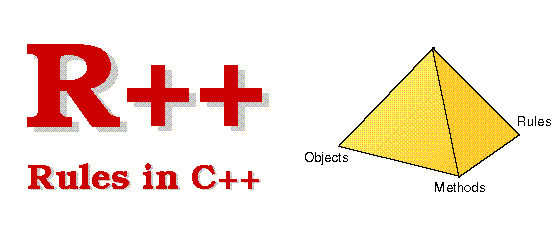
For a perfect example of why software patents are a bad idea we only have to look at the case of R++.
US Patent June 16, 1998, US Patent Number 5768480 Integrating Rules into Object-Oriented Programming Systems.
R++ extends the C++ language with a single new programming construct -- the rule. In addition to data-members and member functions, R++ + adds a new kind of member to C++ classes namely "member rules". A rule is a statement composed of a condition and an action that specifies what to do when the condition becomes true. Whenever some program data changes, rules whose conditions involve that data are examined, and if a rule's condition evaluates to true, its action is executed. The action may of course modify data and therefore trigger other rules. Currently R++ is implemented as a pre-processor. It translates R++ R++ rules into C++ code.
R++ sounds like a fantastic idea of developing safer software, but the lawyers won't let us have it because they can't figure out who owns it. My simple minded solution is put it in the public domain so that we all benefit. "All information should be free" - The Hackers Ethic (not to be confused with the varmints of crackers).
Lucent has a patent on the technology in R++ but AT&T
owns the production version of the software. Commercial
use of R++ is a bit more tricky.
Neither Bell Labs Research nor AT&T Labs Research are in
the business of distributing research generated software for
commercial use.
However, it may be possible for some software vendor to license the rights to R++. This possibility has been investigated in the past, but the AT&T/Lucent breakup and the resulting legal hassles caused problems and the effort was abandoned.
One of the people involved had this to say when I asked what the current status of R++ availability was:
"I was wondering of you could tell me the current status of this R++ legal hang up? ""The current status is that there is no progress. I don't expect any, given the recent changes at AT&T Research."
C++ would not exist out side of the lab today if these new laws where in effect when Bjarne Stroustrup's, created C++ , while at AT&T.
Kind of ironic when one of the research projects, AT&T
LEARNs to PROFIT, is about customer satisfaction. I'm
not a happy customer because I can't play with R++, nor that
fact that I can't get high speed Internet connections from them
in my location.
December 2008:
The problem is that Alcatel-Lucent owns the patent, but AT&T owns the source code. I can probably get Alcatel-Lucent to allow non-commercial use, but I have no pull at AT&T. You are welcome to try to get AT&T Research to release the source code (but to whom, and who to ask?).
You could say to AT&T that I'm willing to try to get Alcatel-Lucent to allow non-commercial of the patent.
As you can see I've tracked down an advocate from the Alcatel-Lucent side, AT&T doesn't answer any emails sent to them anymore.
September 2009:
It seems AT&T has redacted all information about R++ from its web sites, at least I can't find it any more, and the patent #5,768,480 is not on their list of patents.
What do you think this means?
It is important to have AT&T support as they are the official keeper of the R++ source code.
January 2010:
Some one pointed me to Bjarne Stroustrup's paper SELL Rationale that explains the death of R++.
Bjarne Stroustrup's , who created C++ has many interesting things to say about the language.
Articles from Research by AT&T researcher Bjarne Stroustrup:
If your a C programmer who has managed to avoid C++ for all of these years then check out: A Quick C++ Introduction for RCS Library Users.
- A Brief Look at C++
- A Perspective on ISO C++
- What is "Object-Oriented Programming"? (1991 revised version)
- Why C++ is not just an Object-Oriented Programming Language
When will I be able to fit C++ on my AVR or Z8E+?
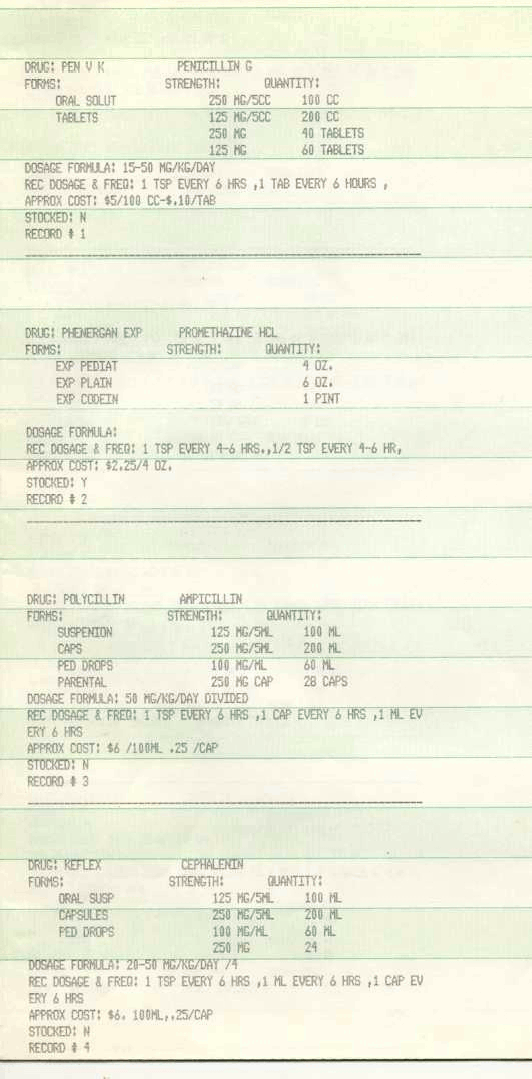
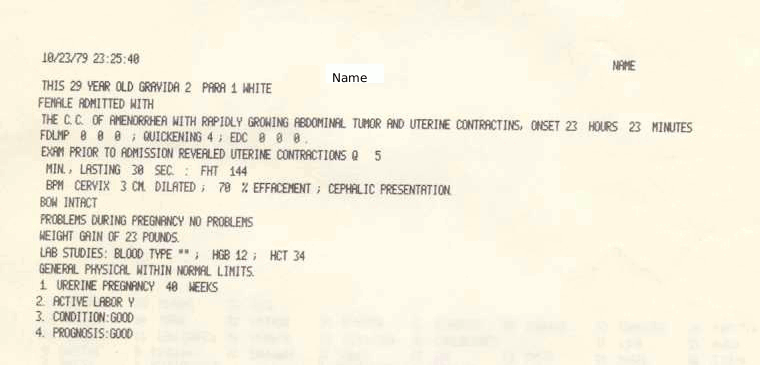
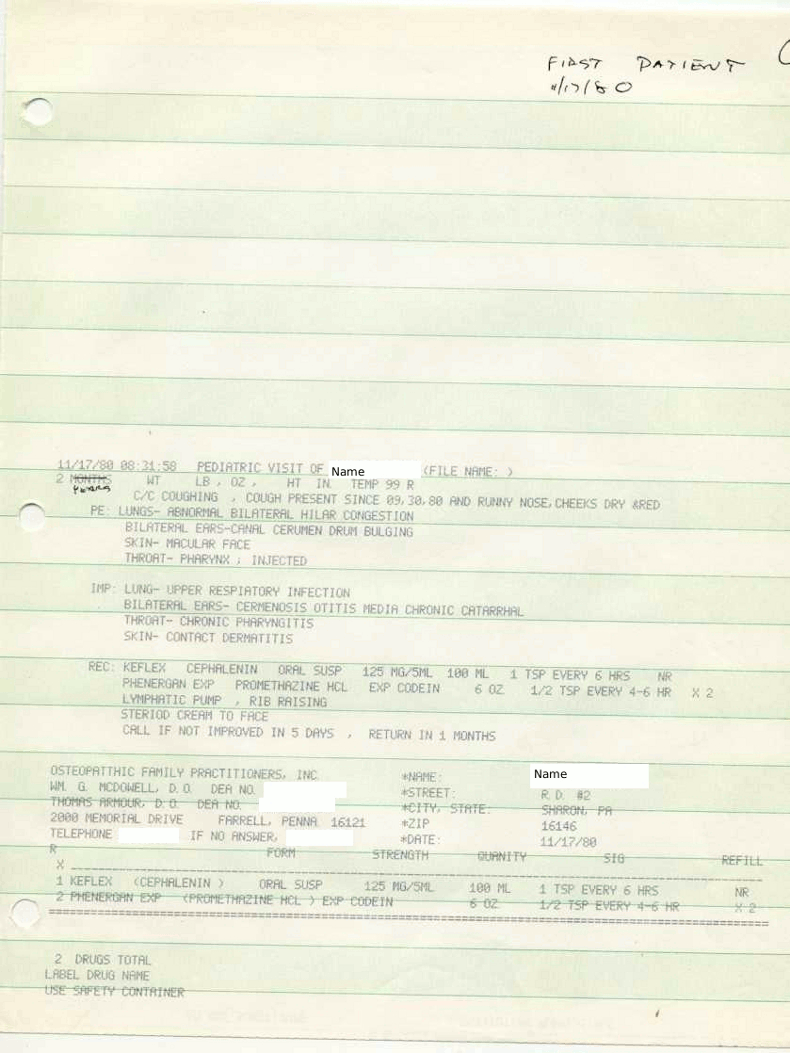
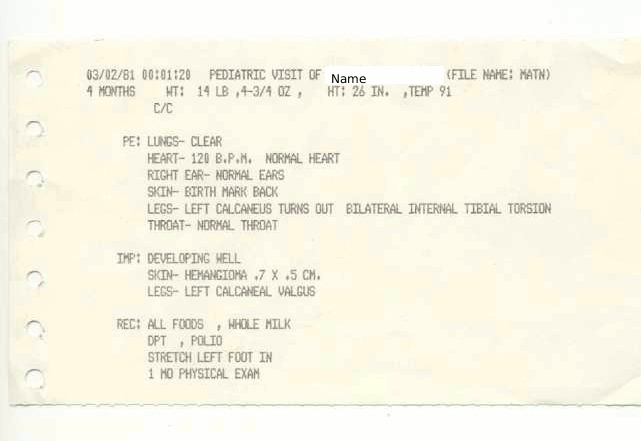
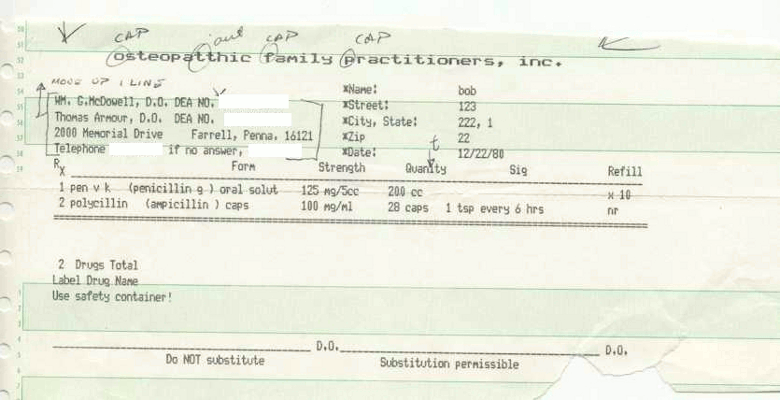
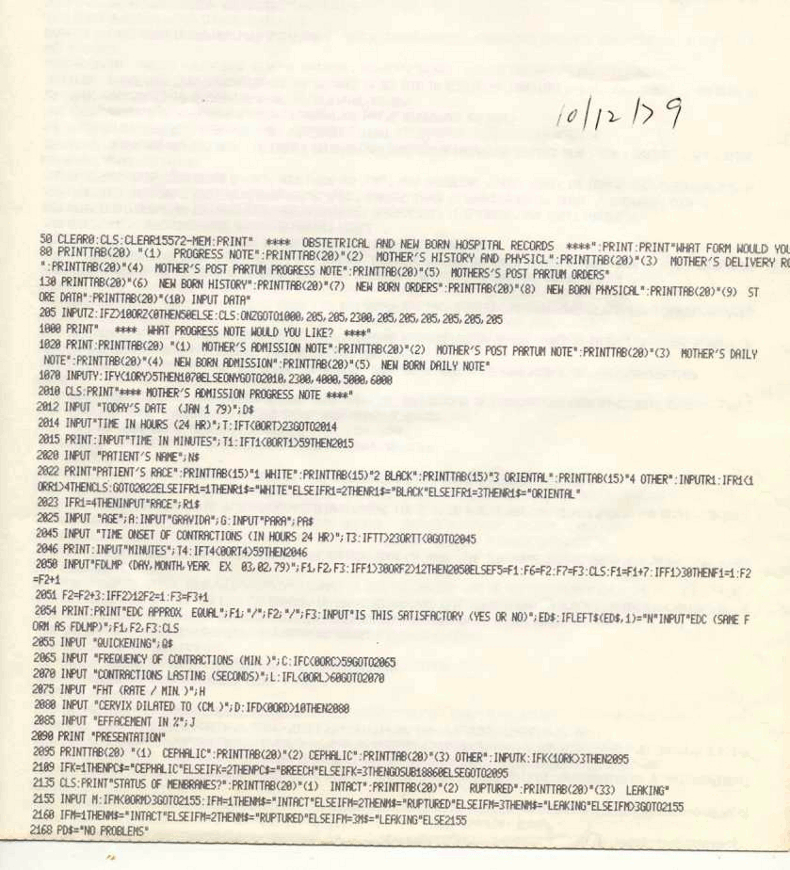
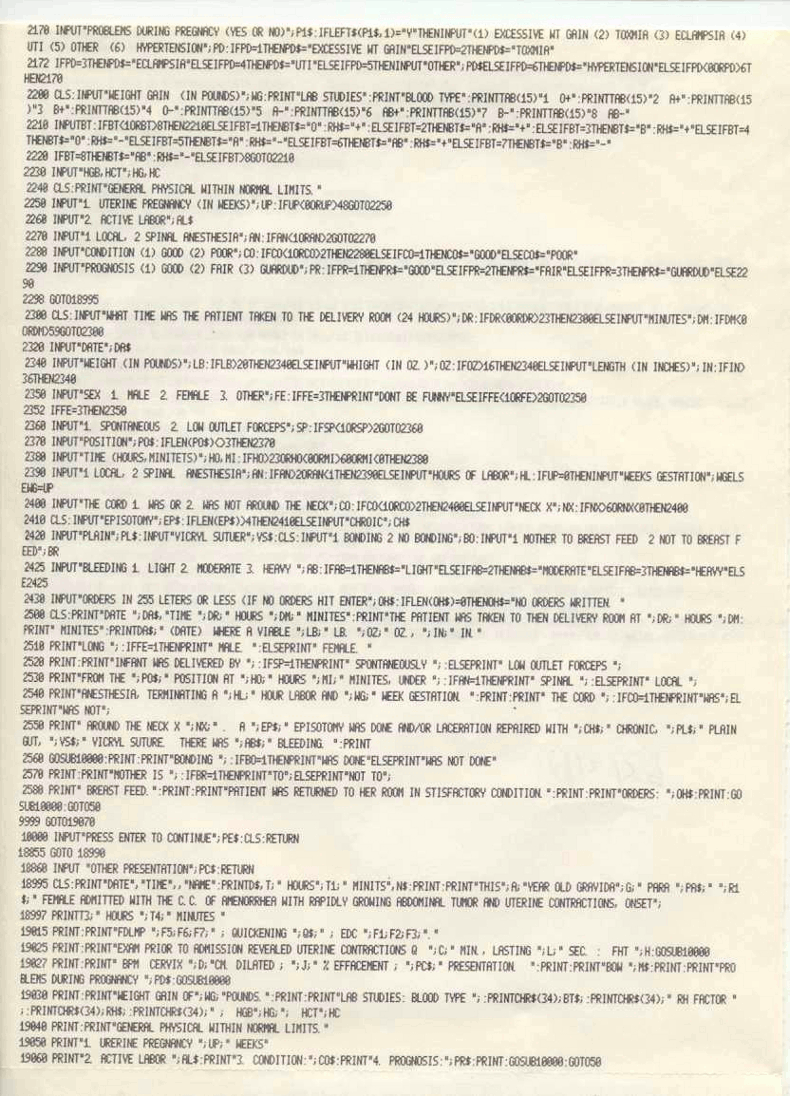
In our Software Safety Blog we had a post about the first electronic prescription, what is now known as E-Prescribing. Fred Trotter said we should post these examples as Prior Art to help out the Open Source Medical Community. We hope to post more in the future but scanning and reading 20+ year old documents is time consuming, so I expect the process to move along slowly.
For the last few years the European Patent Office (EPO) has, contrary to the letter and spirit of the existing law, granted more than 30000 patents on computer-implemented rules of organization and calculation (programs for computers). Now Europe's patent movement is pressing to consolidate this practice by writing a new law. Europe's programmers and citizens are facing considerable risks. Here you find the basic documentation, starting from a short overview and the latest news.
The European Parliament will decide about the legalization and adoption of so-called "software patents" in Europe, which are already used by large companies in other countries to put competitors out of business. This can lead to the termination of many software projects such as TUTOS, at least within Europe, because the holders of the over 30,000 already granted "software patents" (currently without a legal foundation) can claim exclusive rights and collect license fees for trivial things like "progress bars", "mouse clicks on on-line order forms", "scrolling within a window" and similar. That way, software developers will have to pay the "software-patent holders" for using these features, even in their own, completely self-developed applications, which can completely stall the development of innovative software for small and medium companies. Apart from this, the expense for patent inquiries and legal assistance is high, for even trying to find out if the self-developed software is possibly violating "software-patents", if you want to continue to market your software. Contrary to real patents, "software-patents" are, in the current draft, monopolization of business ideas and methods, even without any tangible technical implementation.
Electronic Frontier Foundation as initiated their Patent Busting Project, they need your support.
Patent number 6,727,830: "Time based hardware button for application launch" recently obtained by Microsoft covers the use of such technologies as double-clicking and holding down a button on a PDA. Critics call it yet another example of overly broad patents on familiar technologies.
A case of patenting the obvious, TV remote controls:
United States Patent 6,539,437Remote control inputs to java applications
Abstract
A method of delivering input from a device's remote control to a Java.TM. application uses asynchronous method invocation in a processing device.
The input from the remote control is captured in system-specific (native) code and delivered to a Java.TM. application asynchronously. This is achieved by calling an event method in the Java.TM. application in response to the received input signals. The event method is then executed to transfer the input signals from the remote control.
David Jeske has more to say on the subject of software patents, as does www.softwarepatents.co.uk.
